


Material Selection Guide: Copper Fins vs. Aluminum Fins for Optimal Heat Transfer

I recognize that selecting the right fin material is crucial for optimal Heat Transfer. The central dilemma I face often involves copper versus aluminum fins. I weigh key factors like thermal conductivity, initial cost, and system weight. For example, aCopper Fin Heat Exchanger often delivers superior performance in demanding applications.
Key Takeaways
- Copper fins move heat very well. They are good for strong cooling needs, but they cost more and weigh more.
- Aluminum fins cost less and weigh less. They work well for many cooling jobs where saving money and weight is important.
- Choose copper for tough jobs like marine use. Choose aluminum for everyday items like Home air conditioners.
Performance Comparison for Heat Transfer

Thermal Conductivity Differences
I often start by looking at thermal conductivity. This property tells me how well a material conducts heat. Pure copper, for instance, boasts an impressive thermal conductivity. I see values around 385.0 W/m·K, and sometimes even up to 401 W/m·K at 25°C. This is a very high number. In contrast, pure aluminum has a thermal conductivity of about 237 W m−1 K−1. I notice aluminum's conductivity is significantly lower than copper's. This difference is fundamental. It means copper moves heat away from a source much more quickly than aluminum.
Heat Transfer Efficiency Implications
This difference in conductivity has direct implications for heat transfer efficiency. I understand that a material with higher thermal conductivity reduces thermal resistance. This reduction directly enhances heat transfer. For example, I have learned that a 10% increase in the thermal conductivity of fin material can improve the overall heat transfer coefficient by 6-8%. This coefficient is a key metric. It tells me the total heat exchange capacity. Therefore, using highly conductive materials like copper in fins significantly boosts the heat exchanger's efficiency. This is why senjun focuses on optimal material selection.
Impact on Cooling Capacity
Ultimately, improved heat transfer efficiency directly impacts cooling capacity. I can remove more heat per unit of time when my fins are more efficient. This means the system cools faster or maintains a lower temperature more effectively. For high-performance cooling needs, such as those in medical ultra-low temperature refrigerators or ice makers, I often find that a Copper Fin Heat Exchanger provides superior results. It allows for quicker temperature drops and more stable thermal management. This capability is crucial for many of the products senjun develops, from freezers to display cabinets.
Cost Analysis and Value Proposition
Initial Material Costs
I always consider the initial material costs when selecting fin materials. Copper is a premium material. I see its current market price at 12.51 USD per kilogram. Experts expect this price to reach 6.52 USD per pound in 12 months. This indicates a rising trend. In contrast, aluminum is significantly more affordable. The global average price for aluminum fin stock material is 2.81 USD per kilogram.
| Region | Price (US$/KG) |
|---|---|
| North America | 2.75 |
| Europe | 2.83 |
| Northeast Asia | 3.00 |
| Global | 2.81 |
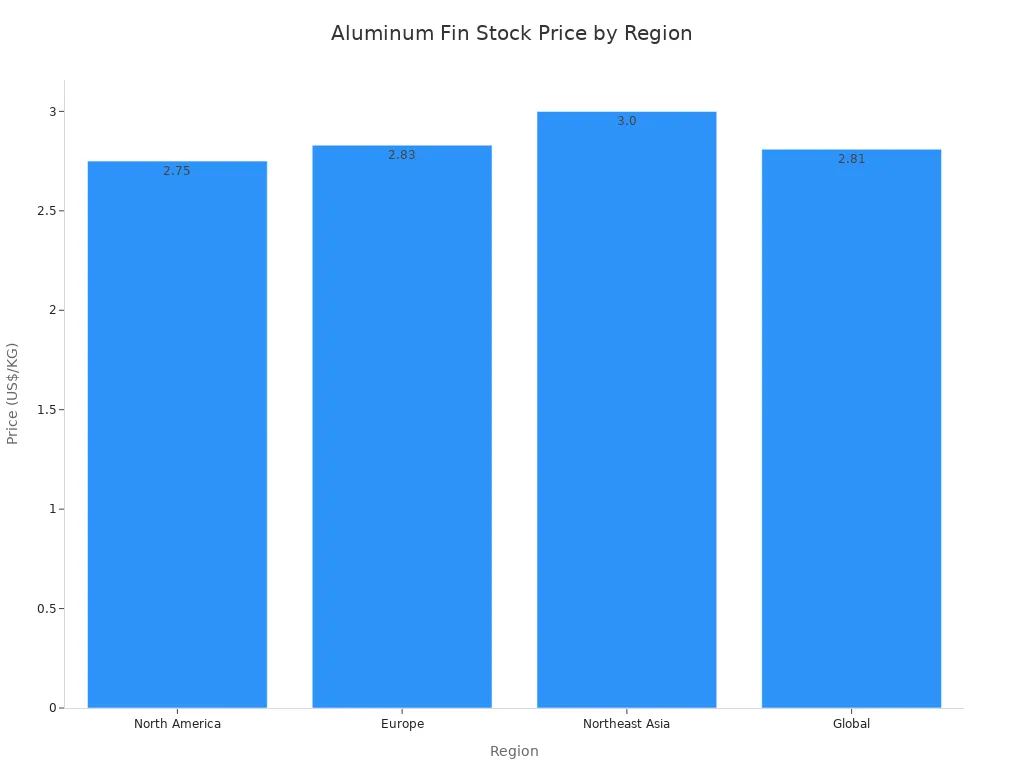
This price difference is substantial. It directly impacts the overall cost of the heat exchanger.
Manufacturing Cost Factors
Manufacturing processes also influence the final cost. Stamping is a common method for creating fins. It is a low-cost, high-volume process for both aluminum and copper sheets. However, aluminum generally has the lowest raw material and manufacturing cost. Copper, on the other hand, is characterized by higher raw material and machining costs. This means that while stamping itself is efficient, the material cost of copper drives up the per-unit cost. senjun carefully evaluates these factors.
Long-Term Value and ROI
I consider the long-term value and return on investment (ROI). While copper has a higher initial cost, its superior thermal performance can lead to long-term energy savings. This is especially true in high-performance applications. Aluminum offers a lower upfront investment. It is suitable for cost-sensitive applications. I weigh the initial expenditure against the expected operational efficiency and lifespan. This helps me determine the best value proposition for each specific product, from refrigerators to wine cabinets.
Weight and Handling Considerations
Density and System Weight
I always consider the density of materials when designing heat transfer solutions. Copper has a density of approximately 8.96 g/cm³. This makes it a relatively heavy material. In contrast, aluminum is significantly lighter. I often refer to its density, which is around 2.7 g/cm³.
| Element | Density (g/cm³) |
|---|---|
| Aluminum | 2.7 |
This substantial difference in density directly impacts the overall system weight. A heat exchanger built with copper fins will inherently weigh more than one using aluminum fins of the same volume. This weight difference becomes a critical factor in many applications.
Specific Thermal Conductivity
I also evaluate specific thermal conductivity. This metric considers a material's thermal conductivity relative to its density. While copper boasts superior thermal conductivity, its higher density means aluminum can sometimes offer a better thermal conductivity-to-weight ratio. This is particularly important when weight is a primary design constraint. I find this balance crucial for optimizing performance without adding unnecessary mass.
Design and Installation Impacts
The weight difference between copper and aluminum fins has significant design and installation impacts. I find aluminum significantly lighter than copper. This simplifies both installation and transport of heat exchangers.
- Copper fin heat exchangers are generally heavier than aluminum counterparts. This leads to higher shipping fees and increased transportation costs.
- The increased weight of copper units necessitates reinforced support structures. This complicates installation and raises project costs.
- Copper's weight can restrict its use in certain applications, such as residential installations. Lighter aluminum fins are preferred for easier handling in these cases.
I must account for these factors in my design process. This ensures the final product meets both performance and practical requirements.
Durability and Corrosion Resistance
Material Longevity
I consider material longevity a critical factor. Copper fins possess a natural protective layer. This layer enhances durability, especially in high humidity or salt exposure. This makes them more resistant to corrosion. I find this leads to a longer service life for a Copper Fin Heat Exchanger. Aluminum fins are more susceptible to corrosion in humid and salty environments. This can cause rapid deterioration. I know protective coatings and treatments are often necessary to mitigate these risks for aluminum.
Environmental Performance
Environmental performance is another key area. Copper's natural resistance to corrosion makes it a preferred choice for marine applications. This significantly reduces maintenance costs and extends lifespan. Copper also mitigates the risk of galvanic corrosion, even in challenging conditions. It resists biofouling. Aluminum, however, shows vulnerability to pitting and galvanic corrosion in marine or coastal environments. Salt air and chloride ions accelerate this. This can lead to leaks and material degradation. I understand galvanic corrosion occurs when dissimilar metals, like copper and aluminum, are in electrical contact. An electrolyte like saltwater exposes them. In copper tube-aluminum fin heat exchangers, galvanic corrosion starts at the fin collars. The aluminum fin corrodes faster there. This leads to excessive fin loss and reduced conductivity.
Surface Treatments and Protection
I often use surface treatments to enhance durability. Aluminum naturally forms a protective oxide layer. To maintain this layer, especially with distilled water and glycol in heat transfer systems, corrosion inhibitors are critical. These inhibitors, often phosphates, form a corrosion-resistant layer. For aluminum fins, precoated coils have a durable organic coating applied before stamping. This coating separates dissimilar metals. It inhibits galvanic action. Postcoated coils feature a tough, baked-on organic coating. Manufacturers apply this uniformly over all coil surfaces after production. Painting with hydrophobic lacquers also waterproofs prepainted aluminum. This makes it more resistant to atmospheric agents. Hydrophilic varnishes absorb excess humidity. This prevents moisture's negative effects on performance.
Manufacturing Methods and Production
Fabrication Processes for Copper
I observe several key fabrication processes for copper fins. These methods ensure strong bonds and efficient heat transfer. I often see solder dipped bonded finned tubes, root solder bonded finned tubes, and brazed finned tubes. These techniques create robust connections. Extruded finning is another method I encounter. This process deforms a thick-walled tube through rotary extrusion. It forms integral fins directly from the tube's material. This results in a continuous structure with excellent heat transfer and mechanical strength. Embedded finning, also known as grooved or G-fin tubes, involves cutting helical grooves into the tube surface. A metal fin strip then winds into these grooves and locks mechanically. L-footed finning (L, LL, and KL fin tubes) wraps a fin strip around the tube, with its 'foot' contacting the surface. Brazed or welded finning directly attaches fins to the tube. This creates a permanent and robust connection for demanding applications.
Fabrication Processes for Aluminum
For aluminum fins, I encounter diverse manufacturing techniques. Skiving uses a 'V' shaped tool to shave a fin from a thick plate of aluminum. It then bends the fin perpendicularly. This allows for high fin height to fin space ratios and very thin fins. Stamping is a common and economical method. It produces aluminum fins from sheet metal using CNC, laser, or traditional mold stamping processes. Folding creates fins from thin, folded sheet metal. Manufacturers then braze or thermally epoxy these onto a plate. Bonded fin heat sinks involve cutting fins from sheet metal and bonding them perpendicularly to a mounting plate. I also see other processes like drawing, which forces metal through a mold. Roll forming continuously bends aluminum strips into desired shapes. Extrusion pushes aluminum alloy through a die. Casting pours molten aluminum into a mold.
Cost and Complexity of Production
I find the choice of manufacturing method directly impacts production cost and complexity. Copper's higher material cost often combines with more intricate bonding or extrusion processes. This can make a Copper Fin Heat Exchanger more expensive to produce. Aluminum's lower material cost, coupled with efficient processes like stamping or roll forming, generally leads to more economical production. However, specialized aluminum processes like deep drawing or precision casting can also add complexity and cost. I weigh these factors carefully. My goal is to balance performance needs with production realities.
Application Suitability and Selection Guide
High-Performance Cooling Needs
I often find copper fins indispensable for high-performance cooling. These applications demand maximum heat dissipation in compact spaces. For example, in High-Performance Computing (HPC), especially within AI clusters and supercomputers, CPUs and GPUs generate significant heat. Copper heat sinks, often with advanced technologies like skived fins, are crucial. They maximize heat dissipation per unit volume for high-end chips and servers. I also see copper fins used extensively in power electronics, electric vehicles, and telecom infrastructure. These are all compact, high-heat-flux environments. Efficient heat dissipation is critical there. A Copper Fin Heat Exchanger consistently delivers the necessary performance in these demanding scenarios.
Cost-Sensitive Applications
For cost-sensitive applications, I typically recommend aluminum fins. Aluminum offers a beneficial combination of thermal conductivity, reduced weight, and lower material expenses. While copper has superior conductivity, it leads to increased weight and higher manufacturing costs. This makes aluminum a more practical choice for many industries. For instance, the home air conditioning industry heavily relies on aluminum. Mass production and raw material costs, which can be 50%-60% of the total, mean rising copper prices directly impact unit costs. Manufacturers are replacing indoor evaporators and some outdoor condenser units with aluminum tube and fin structures to reduce costs. The small appliance industry also prioritizes aluminum. Products like air fryers, dehumidifiers, and mini-refrigerators have low unit prices. Their cost-sensitive consumers benefit from aluminum tube-fin heat exchangers. These meet modest heat exchange requirements effectively. Similarly, the commercial cold chain industry uses aluminum. Applications such as convenience store refrigerators and small cold storage units operate within a temperature range of -30°C to 50°C. Aluminum tube-fin heat exchangers offer suitable weather resistance and heat transfer efficiency. This reduces initial investment costs for businesses.
Weight-Restricted Designs
When designing for weight-restricted applications, I almost always choose aluminum. Its significantly lower density compared to copper makes it the ideal material. For example, in aerospace or portable electronic devices, every gram counts. Using aluminum fins drastically reduces the overall weight of the heat exchanger. This directly contributes to lighter products and systems. I find this crucial for improving fuel efficiency in vehicles or enhancing portability in consumer electronics. The specific thermal conductivity, which considers thermal performance relative to weight, often favors aluminum in these scenarios.
Corrosive Environments and Copper Fin Heat Exchanger Use
I recognize copper's superior performance in corrosive environments. Its natural resistance to corrosion makes it a robust choice. This is especially true in marine applications or areas with high humidity and salt exposure. A Copper Fin Heat Exchanger resists degradation from harsh elements. This ensures a longer service life and reduces maintenance needs. While aluminum requires protective coatings or treatments to withstand such conditions, copper often performs well without extensive additional protection. This inherent durability makes copper a reliable option for long-term operation in challenging settings.
I weigh copper's superior thermal performance against aluminum's cost-effectiveness and lighter weight. Making an informed decision means balancing specific application needs with budget and design constraints. Looking ahead, I see exciting developments. Galvorn, a carbon nanomaterial, shows promise. It aims to surpass both copper and aluminum in thermal conductivity, potentially revolutionizing fin technology.
FAQ
What is the main advantage of copper fins?
I find copper fins offer superior thermal conductivity. This allows for maximum heat transfer efficiency. It is ideal for high-performance cooling applications.
When should I choose aluminum fins?
I recommend aluminum fins for cost-sensitive and weight-restricted designs. They provide good thermal performance at a lower material cost and lighter weight.
Can I use copper and aluminum together in a heat exchanger?
I advise caution when combining them. Galvanic corrosion can occur. This happens when dissimilar metals are in contact, especially in humid or corrosive environments. ⚠️