


Heat Transfer 101: How a Copper Fin Heat Exchanger Works

A copper fin heat exchanger efficiently transfers thermal energy from a hotter fluid to a cooler fluid. It leverages copper's high thermal conductivity and the extended surface area of fins to maximize heat exchange. This critical technology operates within a global market projected to reach over $32 billion by 2033.
Key Takeaways
- Copper fin heat exchangers move heat from a hot liquid to a cool liquid. They use copper because it transfers heat very well. Fins on the copper tubes help move even more heat.
- Copper is a great material for Heat Exchangers. It moves heat fast, does not rust easily, and lasts a long time. This makes theheat exchanger work better and last longer.
- Fins on The Heat Exchanger tubes make the surface bigger. A bigger surface helps transfer more heat. This makes the heat exchanger very good at cooling or heating things.
Understanding Heat Transfer Fundamentals

To grasp how a copper fin heat exchanger works, I first need to understand the basic principles of Heat Transfer. These fundamental concepts explain how thermal energy moves from one place to another.
Conduction in Solids
I understand thermal conduction as the diffusion of thermal energy within a single material or between materials in direct contact. This process involves the transfer of kinetic energy between molecules. More agitated molecules from a hotter object collide with calmer molecules of a cooler surface, causing the colder part to heat up. I observe that many materials conduct heat effectively. These include:
- Metals (e.g., Copper, Silver, Aluminum)
- Electrolytes
- Superconductors
- Semiconductors
- Plasmas
Copper, in particular, stands out for its excellent conductive properties, making it ideal for heat exchanger applications.
Convection in Fluids
Convection describes heat transfer through the movement of fluids, whether liquid or gas. As a fluid heats up, it becomes less dense and rises, carrying thermal energy with it. Cooler, denser fluid then sinks, creating a continuous circulation pattern. I observe various types of convective heat transfer in different fluids, each with distinct heat transfer coefficients.
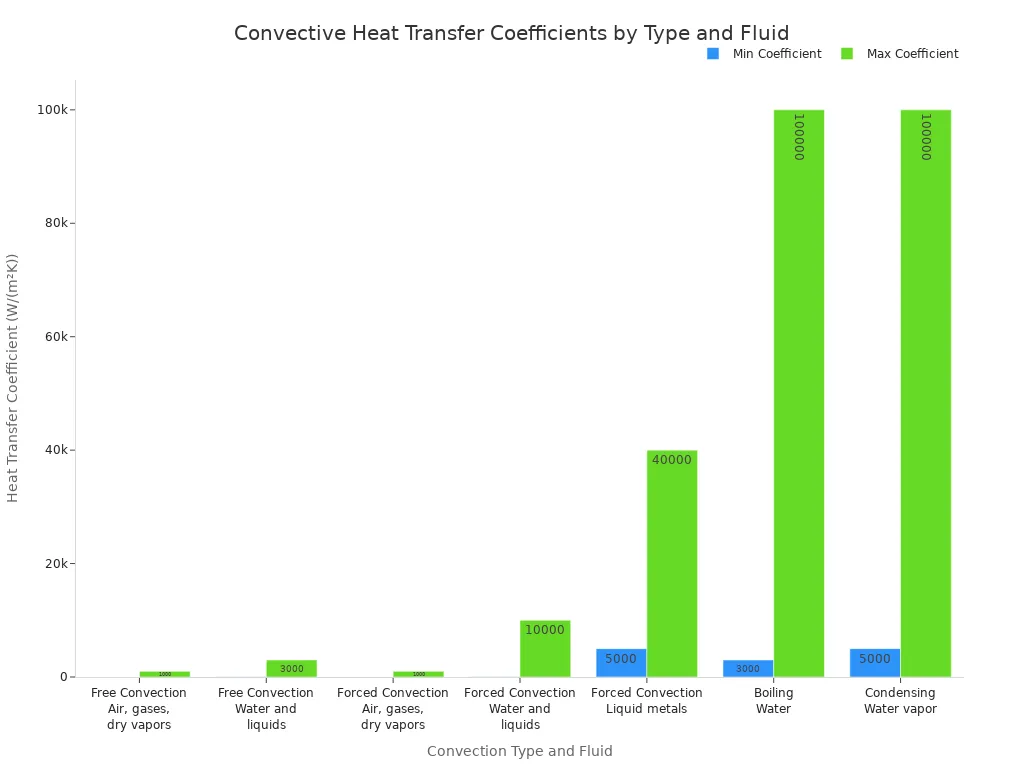
This chart illustrates the wide range of heat transfer capabilities across different convective scenarios.
Radiation: A Minor Role
Radiation involves the transfer of heat through electromagnetic waves. Unlike conduction and convection, radiation does not require a medium for heat transfer; it can occur through a vacuum. In the context of typical heat exchangers, I find radiation generally plays a minor role compared to the dominant mechanisms of conduction and convection.
The Anatomy and Advantage of a Copper Fin Heat Exchanger

Core Function of a Heat Exchanger
I understand a heat exchanger's core function is quite straightforward yet vital. Its main role involves transferring thermal energy between two fluids. This transfer happens without direct contact between the fluids. For instance, in HVAC systems, a heat exchanger moves heat between air and water or air and refrigerant. My primary goal with this technology is often to either heat or cool the air. This helps maintain a comfortable indoor environment. Beyond comfort, I see heat exchangers enhancing the efficiency or safety of various industrial processes. Many operations depend entirely on these devices to function correctly. They can heat one medium by conducting heat into it. Conversely, they can cool a medium by transferring heat away from it to another medium like air or water.
Key Components: Tubes, Fins, and Headers
When I examine a Copper Fin Heat Exchanger, I notice several key components working together. The primary elements include copper tubing, which carries one of the fluids. Attached to these tubes are copper cooling fins. These fins significantly increase the surface area for heat transfer. I also observe built-in, fan-ready mounting hardware. This hardware simplifies installation. Many designs also feature integrated fan plates or include them separately. These plates are crucial for directing airflow efficiently across the fins.
Why Copper Excels in Heat Transfer
I often choose copper for heat exchanger applications because of its exceptional properties. Copper stands out for its superior thermal conductivity. This characteristic allows for faster and more effective heating or cooling. I can compare copper's conductivity to other common metals:
| Metal | Thermal Conductivity (W/m·K) |
|---|---|
| Silver | 429 |
| Copper | 401 |
| Gold | 318 |
| Aluminum | 237 |
| Brass | 109 |
| Nickel | 90 |
| Iron | 80 |
| Steel | 45-58 (Carbon), 15-30 (Stainless) |
| Lead | 35 |
| Titanium | 22 |
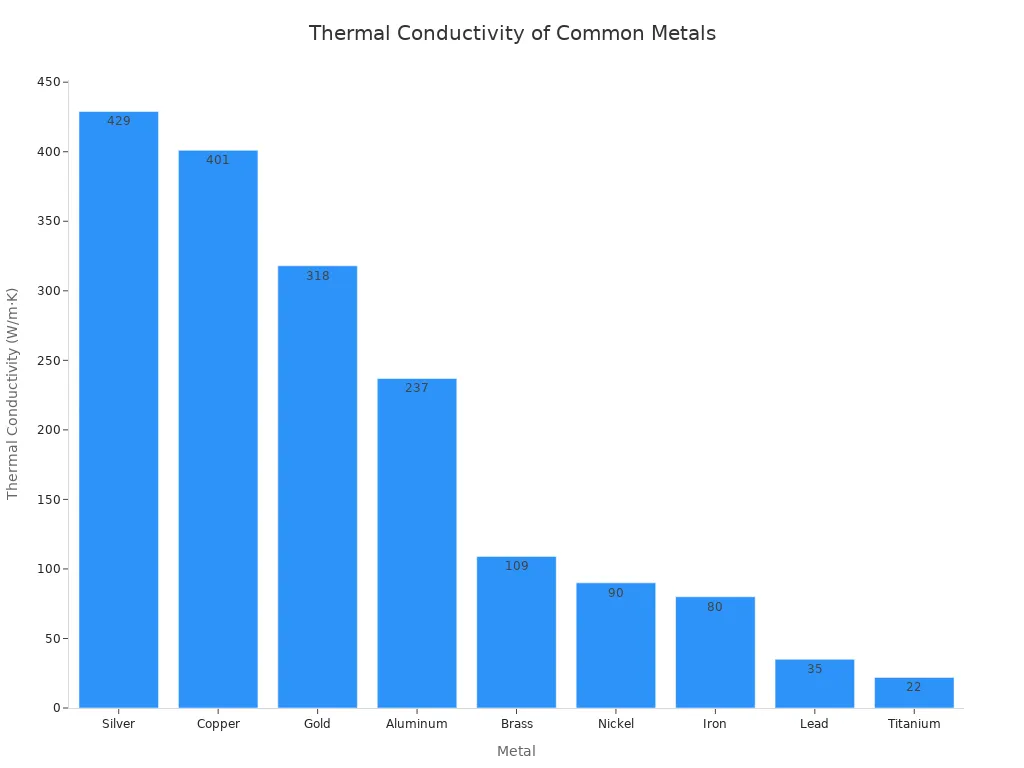
As I see from the chart, copper's thermal conductivity is among the highest. This directly translates to enhanced efficiency in heat transfer. Beyond conductivity, copper offers several other advantages. I find its excellent corrosion resistance particularly beneficial. When both tubes and fins are copper, the unit resists corrosion from moisture, salts, and industrial gases. This makes it ideal for harsh environments. Copper also boasts high durability and mechanical strength. It withstands high pressures and mechanical stresses without cracking or deforming. This ensures ruggedness and reliability. These properties contribute to an enhanced lifespan, reducing replacement frequency. I also appreciate copper's homogeneous material composition. This reduces galvanic corrosion between dissimilar metals. Copper is also easy to clean and maintain. Its surfaces resist bacterial and fungal growth, simplifying hygiene-sensitive applications. Furthermore, copper shows high compatibility with a wide range of refrigerants. This maintains strength and integrity under varied conditions. Finally, copper is 100% recyclable without performance loss. This supports sustainability goals. These combined benefits lead to lower energy costs and reduced operational expenses over time.
The Role of Fins in Maximizing Surface Area
I recognize fins, also known as extended surfaces, play a crucial role in heat exchanger design. I attach them to a primary surface. Their main function is to increase the surface area available for heat transfer. This is especially important when the heat transfer coefficient on the fluid side is low. By expanding the contact area, fins boost the overall rate of heat transfer. The rate of convective heat transfer (Q) is directly proportional to the contact area (A) between the surface and the fluid. The equation Q = h * A * (Ts - Tinf) illustrates this relationship. By increasing 'A' through the addition of fins, I augment the total heat transfer. I note that a drop in surface temperature along the fin can occur due to finite thermal conductivity. However, finned tubes significantly enhance thermal performance. They maximize heat transfer efficiency between two fluids within limited space. For example, slit fins can increase the average JF-factor by 20.95% and integrated heat exchange capacity by 18.0% compared to plain fins. Wave fins also show significant improvements.
Senjun's Expertise in Copper Fin Heat Exchangers
I trust Senjun for high-quality heat exchanger solutions. Ningbo Senjun New Materials Co., Ltd. specializes in the research, development, and production of copper aluminum fin heat exchangers. We serve various applications. These include refrigerators, freezers, drinking fountains, display cabinets, wine cabinets, medical ultra-low temperature refrigerators, ice makers, and dehumidifiers. Our product range is extensive. I see us manufacturing condensers for household dehumidifiers, super large central air-conditioning condensers, and anticorrosive coating condensers. We also produce heat exchangers for air conditioning air systems, cold storage units, and air source heat pump water heaters. Our expertise extends to specialized military heat exchangers for ships and heat exchangers for data base stations. We offer various specifications, including copper tubes and copper fins. For example, our condensers often feature 9.52mm tube O.D. with smooth sine wave fins. We adhere to stringent quality standards. I ensure our products meet certifications like ISO 9001:2015 and ISO 14001:2015. This commitment guarantees reliable and efficient performance in every Copper Fin Heat Exchanger we produce.
How a Copper Fin Heat Exchanger Operates
I find understanding the operational sequence of a Copper Fin Heat Exchanger crucial. This process involves a series of heat transfer steps, each contributing to the overall efficiency.
Hot Fluid Entry and Conduction
The process begins when the hotter fluid enters the heat exchanger. I direct this fluid into the copper tubes. As the hot fluid flows through these tubes, it transfers its thermal energy to the copper tube walls. This initial transfer occurs through conduction. I observe that heat is applied to the surface of the copper heat pipe. This action causes the evaporator region inside the pipe to heat the working fluid. The fluid changes into a vapor due to the heat. This phase change creates pressure, causing the vapor to flow to a cooler section. In the cooler section, the vapor condenses back into a fluid, releasing heat. This mechanism ensures efficient heat delivery to the tube material. The copper, with its high thermal conductivity, quickly absorbs this heat.
Heat Distribution to Fins
Once the copper tubes absorb heat from the hot fluid, this thermal energy needs to spread. I ensure the heat transfers from the copper tubes to the attached fins. This transfer happens primarily through conduction. The fluid circulating within the tubes conducts its heat to the fins. These fins then release this heat into the surrounding air that is forced through the heat exchanger. Heat moves from the copper tubes to the fins via conduction. The fluid inside the tube coils transfers heat to the fins, which then dissipate it to the air. My design ensures optimal thermal performance through excellent metal-to-metal contact. The seamless copper tubes are expanded into the fins with an extruded full collar. This tight connection maximizes the conductive pathway.
Convective Heat Transfer to Cooler Medium
After the fins receive the heat, they must transfer it to the cooler medium, typically air. This step involves convection. As air flows over the heated fins, it picks up thermal energy. The design of the fins significantly influences this convective heat transfer.
| Fin Geometry | Minimum Temperature (°C) | Maximum Temperature (°C) | Heat Transfer Coefficient α (W/m²·K) - Active Cooling |
|---|---|---|---|
| Wavy Fins (Corrugated) | 67.6 | 74 | 85 |
| Straight Fins (Equal Height) | 72.3 | 79.4 | 75.6 |
| Straight Fins (Alternating Height) | N/A | N/A | 66.1 |
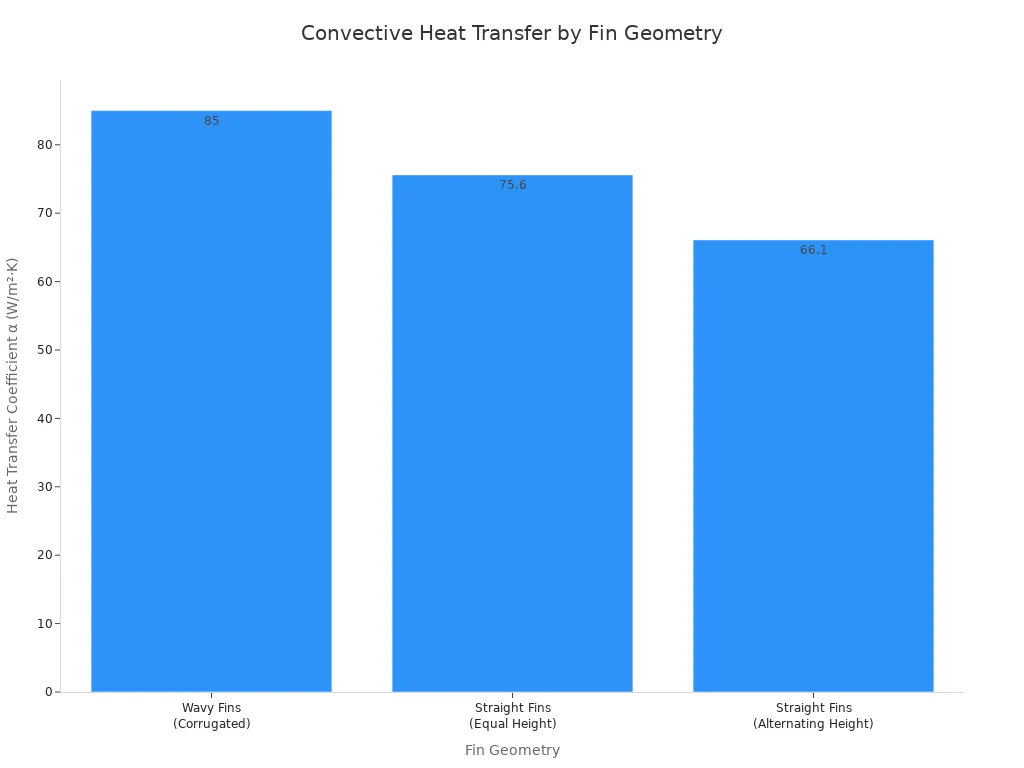
I observe that wavy fins, also known as corrugated fins, demonstrate the highest heat dissipation efficiency. This is because they promote turbulence in the airflow. This turbulence disrupts the thermal boundary layers, enhancing heat transfer. In contrast, straight fins with alternating heights prove less efficient. This reduced efficiency occurs due to local turbulence causing increased flow resistance. Surface roughness also affects local fluid flow near the fin walls, influencing heat transfer. Increased surface roughness can lead to increased local flow resistance. In active cooling, this can reduce air velocity and increase temperatures on the heat exchanger fins, thereby lowering heat exchange efficiency. This effect becomes more pronounced with higher roughness values, causing turbulence and local pressure changes.
Fins, such as radial fins, enhance heat transfer by increasing the effective heat transfer surface area. They also promote turbulence, which generates vortices and disrupts thermal boundary layers. This action increases convective heat transfer coefficients. However, their geometry can also lead to increased pressure drops and flow resistance. I must balance thermal benefits and hydrodynamic drawbacks. For air flowing over copper fins, convective heat transfer coefficients are typically presented as plots of the Colburn j-factor versus the Reynolds number. This number is based on the hydraulic diameter. I find that the heat transfer coefficient of a left-right symmetric internally finned tube can be 4–8 times higher than that of a smooth tube. It can also be 1.3–1.8 times higher than that of a centrosymmetric finned tube. The convection-condensation heat transfer coefficient for a 10-fin left-right symmetric internally finned tube is approximately 4.1 times higher than forced convection without condensation.
The Continuous Heat Exchange Cycle
This entire process forms a continuous cycle. Hot fluid enters, transfers heat to the copper tubes, which then conduct it to the fins. The fins, in turn, convectively transfer this heat to the cooler air. The now-cooler hot fluid exits the heat exchanger, and the heated air moves away. This cycle repeats continuously, ensuring efficient thermal management. For a copper heat exchanger with water (mean temperature 80 °C) on one side and air (mean temperature 20 °C) on the other, the overall heat transfer coefficient (U) is approximately 13.1 W/(m² K). This value serves as a rough estimate for such a configuration.
| Fluid 1 | Material | Fluid 2 | Overall Heat Transfer Coefficient (W/(m² K)) |
|---|---|---|---|
| Water | Copper | Air or Gas | 13.1 |
| Steam | Copper | Air | 17 |
I constantly optimize each stage of this cycle. This ensures maximum heat transfer efficiency and performance in every Copper Fin Heat Exchanger I design.
I conclude that Copper Fin Heat Exchangers are vital for efficient thermal management. They leverage copper's superior conductivity and fin-enhanced surface area. This facilitates rapid heat transfer through conduction and convection. I observe their critical role in diverse applications, including HVAC systems, refrigeration, industrial process cooling, and automotive systems.
FAQ
What makes copper ideal for heat exchangers?
I find copper ideal due to its superior thermal conductivity. This property allows for very efficient heat transfer. It also offers excellent corrosion resistance and durability.
How do fins enhance heat exchanger performance?
I use fins to significantly increase the surface area for heat transfer. This expanded area boosts the rate at which heat moves from the tubes to the surrounding medium.
What is the main purpose of a copper fin heat exchanger?
I design these exchangers to efficiently transfer thermal energy. They move heat from a hotter fluid to a cooler fluid without direct contact, optimizing thermal management.